
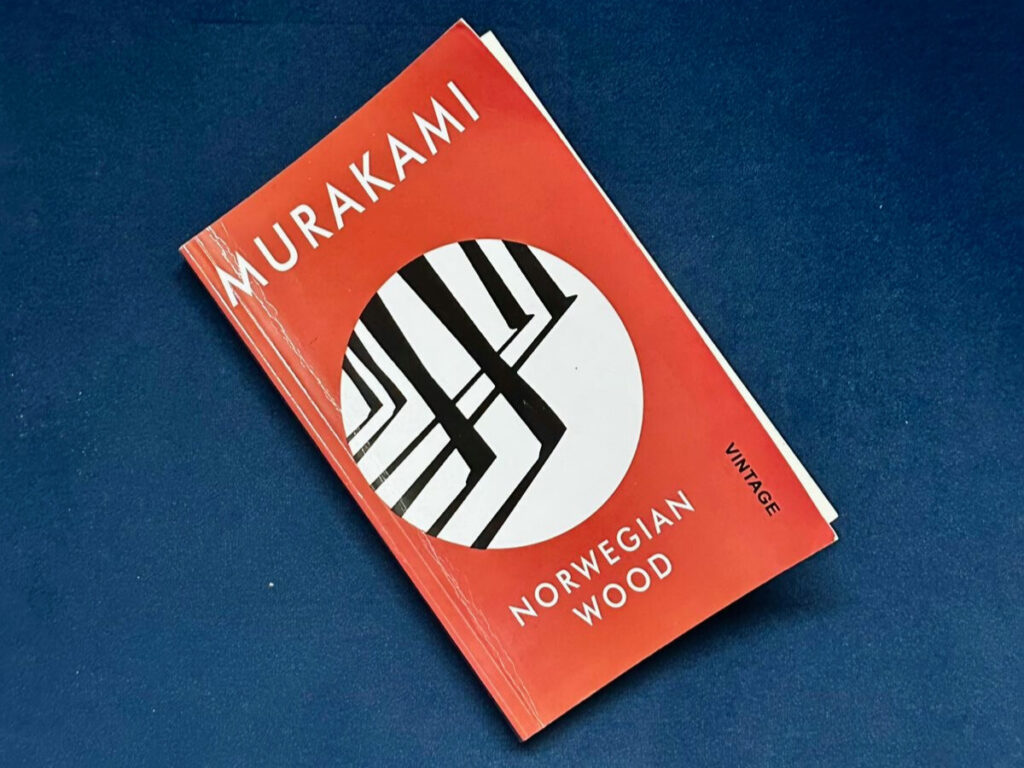
For months, my feeds were littered with whispers about Murakami. Quotes floating around like fragments of wisdom, reels urging me to read Norwegian Wood, endless debates about its brilliance. So when I spotted a copy tucked away on a bookstore shelf, I gave in and decided it was finally time to see what the fuss was all about.
Norwegian Wood is often regarded as a love story. I think it is also something darker: a portrait of how unresolved grief and mental illness quietly hollow out a life and never quite let go.
Beneath the tangled romances and the aimless drifting of youth, Murakami circles something that struck me far harder than the nostalgia: Japan’s unspoken struggle with depression, isolation, and suicide.
Author: Haruki Murakami
Genre: Contemporary Fiction
Original Language: Japanese (translated to English by Jay Rubin
Pages: ~350
Pace: Slow
My Rating: 3 /5
/5
Best For: Fans of slow-burn stories
Trigger Warnings: Misogyny, Substance Abuse, Suicide, Mental health struggles
Norwegian Wood is often called a love story. It is, but only on the surface.
At its heart, it follows Toru Watanabe — a young man who moves to Tokyo for university, less out of ambition and more out of a need to escape. There, he reconnects with Naoko, the girlfriend of his late best friend and his own first love. Their bond is fragile from the start, shadowed by grief, and it becomes clear early on that love alone cannot keep Naoko from slipping into her own darkness.
Along the way, Toru meets people who each leave a mark on him: Midori, spirited and life-affirming; Nagasawa, charismatic but hollow; Hatsumi, quietly suffering; and Reiko, Naoko’s confidante. Every one of them is carrying something they cannot put into words.
And that is what makes this novel linger.
Almost every character in Norwegian Wood, all in their late teens or early twenties, is quietly unraveling. Depression, loneliness, and the weight of unspoken expectation seep into their lives in ways no one around them seems to notice or name. Watanabe’s story isn’t really about choosing between two women. It’s about moving through a world where young people are profoundly adrift, reaching for connection in all the wrong places.
The question the novel quietly keeps asking is: why are they all so lost?
When Japan emerged from World War II, it was a nation in ruins- physically, politically, and emotionally. Sweeping reforms reshaped society almost overnight, and the Korean War fuelled Japan’s “economic miracle,” turning it into an export powerhouse by the late 1960s. On the surface, a story of resilience.
But the psychological undercurrent told a different story. Historian John Dower described the national mood as kyodatsu- a deep exhaustion and spiritual disorientation after decades of militarism and defeat. And it wasn’t just one war. From the Sino-Japanese War of 1894 through to 1945, Japan endured an almost unbroken chain of conflict. Generations grew up under militaristic ideals that glorified sacrifice and stoicism. The result wasn’t simply post-war trauma; it was a compounded legacy of disillusionment, shame, and silence around suffering.
Talking openly about depression was tantamount to admitting personal failure. Mental illness was dismissed as weakness, rarely seen as something worthy of treatment.
Institutionally, Japan leaned heavily on hospitalisation. The Mental Hygiene Law of 1950 triggered a boom in psychiatric institutions, and by the 1960s, involuntary long-term admissions had become the norm, even for patients who were neither dangerous nor acutely ill. The more isolated patients became inside hospitals, the stronger the stigma grew outside them.
Japan’s cultural relationship with suicide runs deep. In the age of the samurai, death was not merely an end but a moral act. Seppuku, ritual self-disembowelment, was the ultimate expression of honour and loyalty. The tale of the 47 Ronin, who avenged their master only to be ordered to take their own lives, still resonates in Japanese cultural memory. Equally, the shinju, or lovers’ suicide, celebrated in Chikamatsu’s plays, cast death as a final declaration of devotion when social duty clashed with personal desire.
Though ritual suicide is no longer practiced, the idea of kakugo no jisatsu, a “suicide of resolve”, persists. In 2004, the chairman of a Japanese poultry company and his wife hanged themselves amid an investigation into their failure to report a bird flu outbreak on their farm. Their deaths were widely read as an act of accountability, an apology through self-destruction.
Even today, suicide is not always perceived as irrational despair but sometimes as a rational, even virtuous, choice. Suicides tied to shame or failure, in politics, business, or personal life, still make headlines. Studies show Japanese students report higher acceptance of suicide as an escape than their American peers, and media and literature have long romanticised self-destruction, cementing its place as a socially comprehensible, if tragic, option.
Japan’s suicide rate has dropped significantly over the past 50 years, yet it remains stubbornly high — 16.4 per 100,000 people as of 2024. Most troubling is the trend among the young: 527 students from elementary through high school died by suicide that year, the highest number since records began. The pressures driving this are layered. Economic stagnation and a culture of overwork trap adults in cycles of hopelessness. An ageing population means millions of elderly citizens face profound isolation. Among the young, school bullying, relentless academic expectations, and cyberbullying have become leading triggers.
Yet perhaps the most persistent factor is silence. Counselling rates in Japan linger around 6%, compared to over 50% in parts of Europe and the US. Admitting depression or suicidal thoughts is still widely seen as a shameful burden on one’s family. This stigma is not unique to Japan; India, despite a lower rate of 12.4 per 100,000, leads the world in total suicide deaths by sheer population, with young women disproportionately affected. Even the US, at 14.7 per 100,000, struggles despite wider access to mental health resources. Across cultures, the pattern holds: where shame silences suffering, the crisis deepens.
Within this weight of history, there are signs of change. Japan’s Gen Z is far more vocal about therapy and mental health, and clinics in Tokyo and Osaka are seeing an uptick in young people seeking help for stress and burnout. Social media, despite its role in cyberbullying, has also created spaces for solidarity- hashtags and support communities on LINE have allowed young people to express suicidal thoughts without immediate judgment. The 2020 death of actress Yuko Takeuchi prompted celebrities to speak openly about their own struggles, breaking a silence that had held for generations. Universities, local governments, and community programs are slowly following suit.
The stigma has not disappeared, and the rates remain high. But silence is no longer the only response, and that, perhaps, is where change begins.
Norwegian Wood by Murakami may not have been the story I expected. Still, it became something more, an unflinching mirror into Japan’s quiet struggles with mental health, struggles I had only glimpsed in passing on social media.
It reminded me that even a country celebrated for its beauty and wisdom, the same Japan that gave us philosophies like Ikigai, carries scars etched by decades of war and identity crises.
In tracing those wounds, I found myself thinking not just about Japan, but about how every society hides its own fractures beneath the surface. And perhaps that is the true gift of literature: it pushes us to look closer, to ask difficult questions, and to carry conversations across borders. Because in the end, pain, and the will to heal it, is not Japanese, or Indian, or American. It is human. And maybe the answer lies in what Murakami leaves us with: “What happens when people open their hearts? They get better.”
Thank You for reading our Blogs and Learning from our experience.
For your daily dose of life in all its beauty & imperfections

Masternee
Your Mind’s Favourite Blog
Copyright © 2024 Masternee. All Rights Reserved.