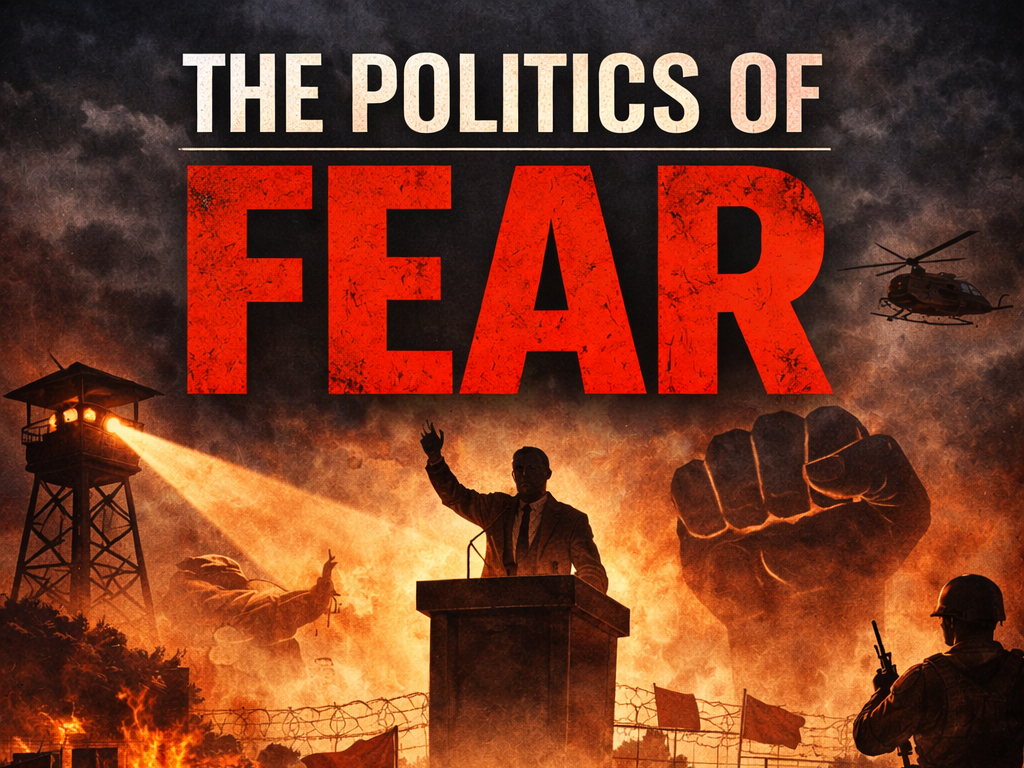

Every leader, at some point, stops being admired. The promises wear thin. The myth cracks. The crowd that once cheered starts to ask questions.
But power rarely disappears when admiration does. It just changes its strategy.
Instead of inspiring people, it starts frightening them. Instead of promising a better future, it points to a threat. And suddenly, the question is no longer “Is this leader doing a good job?”, it’s “What happens if the other side wins?”
That shift, from inspiration to fear, is one of the oldest tricks in politics. And it’s playing out right now, in countries across the world.
You’ve seen the signs: an “enemy” that keeps getting mentioned, a threat that’s always just around the corner, a sense that your way of life is under attack.
That’s the politics of fear, and its goal isn’t really to protect you. It’s to keep you too anxious to ask hard questions.
Fear works because it doesn’t need to be proven. It just needs to be felt. And it rarely starts from nothing- it latches onto real frustrations: job insecurity, cultural change, a sense that the system isn’t working for you. Politicians don’t create these feelings. They just give them a target.
And once they do, the target becomes easier to see than the system that created the frustration in the first place.
Once fear becomes the operating system of a government or movement, it runs on a few reliable tools:
Inventing enemies. A group, defined by religion, ethnicity, or identity, is framed as a danger. The threat is made to feel urgent, even existential. If we don’t act now, everything we have will be lost. The enemy doesn’t need to be powerful. It just needs to be visible.
Moral panic. Culture becomes the battlefield. Values are “eroding.” Traditions are “disappearing.” Women’s bodies and choices are often policed most heavily here, framed as protecting something sacred, when really it’s about control. The language of preservation is almost always the language of restriction.
Loyalty through opposition. You prove you belong not by what you support, but by what you oppose. Dissent starts to look like betrayal. Asking questions starts to feel dangerous. And slowly, the space between disagreement and disloyalty disappears entirely.
Germany- In 1930s Germany, Hitler didn’t rise on hate alone. He rose on grievance given a face. Economic collapse, national humiliation, a country that felt it had been robbed of its dignity. These were real wounds. What he offered wasn’t healing, it was a target. Jewish people, communists, the “enemies within.” Fear became the architecture of the state. And by the time most people understood what was being built, they were already living inside it.
U.S- Decades later, the materials are different but the construction is familiar. During Trump’s presidency, the threat wasn’t economic collapse, it was cultural displacement. Immigration. The media. The “elites.” The message, repeated across rallies and tweets and prime-time segments, was consistent: something is being taken from you, and I am the only one who sees it. Loyalty was demonstrated not through policy support, but through shared opposition- to institutions, to the press, to anyone labelled an outsider. The enemy kept shifting. The fear stayed constant.
India- In India, the architecture looks different again, but the load-bearing walls are the same. Nationalism, cultural preservation, the idea that a civilization is under threat from within. These narratives have, at times, positioned entire communities as questions the nation must answer. The result isn’t always violence. Sometimes it’s subtler: a climate where criticism feels like provocation, where asking who benefits from this fear is itself treated as suspicious.
The specifics differ. The intensity varies. But in each case, the move is the same, complexity is expensive, fear is cheap, and an enemy is the fastest way to make people stop asking questions and start picking sides.
Admiration is high-maintenance. It needs a leader to keep delivering- results, credibility, moral authority. The moment performance slips, belief starts to erode.
Fear is far cheaper to sustain. It doesn’t need evidence, it just requires repetition. A threat, stated often enough and in enough different ways, begins to feel self-evident. And once it takes hold, it does something admiration never could: it makes questioning feel risky.
When everything feels like survival, scrutiny looks like a luxury you can’t afford. That’s not an accident. It’s the point.
The damage from fear-based politics is slow, cumulative, and easy to miss until it’s already done.
Complex problems get reduced to simple villains. People stop being individuals and become categories- aligned or opposed, inside or outside, loyal or suspect. Institutions- courts, press, universities, get dismissed as compromised, not because they’ve failed, but because independent institutions are inconvenient for power that runs on fear.
And division, which once felt extreme, starts to feel like common sense.
The quietest cost is this: things that once required proof now only require repetition. And by the time people notice how far the line has moved, they’re already defending positions they would have found unthinkable a decade ago.
Fear is effective. But it isn’t permanent.
Narratives fracture. Contradictions surface. The leader who once seemed untouchable starts to look like what they always were- someone holding power together with anxiety, not ability.
But here’s what history keeps showing us: by the time accountability arrives, a lot has already changed. Beliefs have hardened. Divisions have deepened. And the people who asked questions early, the ones who said wait, who exactly is this enemy, and who benefits from us being afraid of them, were the ones who paid the highest price for asking.
Which is, perhaps, the most important thing fear does. It doesn’t just protect power from its critics. It makes criticism feel like the thing that needs to be justified, not power itself.
And as long as that inversion holds, accountability will keep arriving exactly when it always does.
Too late, and at too high a cost.
If you haven’t read the first part of this series yet, you can find it here-
The Comfort of Greatness
Thank you for reading my blog and learning from my experience.
For your daily dose of life in all its beauty & imperfections

Masternee
Your Mind’s Favourite Blog
Copyright © 2024 Masternee. All Rights Reserved.