

As we recover from the tear-jerking finale of Stranger Things and soft launch ourselves into the upside down of the corporate life there are a few things we can take away from these characters that could help us survive the unexpected demogorgans & mind-flayers at your workplace.
If there’s one thing Stranger Things captures perfectly, it’s that people don’t turn into who they are overnight. They become that slowly- through pressure, repetition, expectation, and silence.
Work does that to us too.
Most of us didn’t consciously decide who we’d become at work. Somewhere between our first “quick call” and our hundredth “just circling back,” it just… happened. And like Hawkins, offices have their own Upside Down too. Less dramatic, perhaps, but equally disorienting.
So consider this as that mirror which reveals not just who you are today, but also what you could become. Because you’re rarely just one character. You shift. You adapt. And sometimes, you just survive.
What works in your favour
You don’t speak often, but when you do, it matters. You focus deeply, deliver consistently, and don’t confuse visibility with value. Your work has weight, even when your presence is understated.
What this costs you
Your silence is often mistaken for distance. You may be overlooked, overloaded, or assumed to be “fine” simply because you don’t say otherwise. Power without protection can become exhaustion.
Your survival rules
Office truth: Every team depends on an Eleven, even if they rarely acknowledge it.
What works in your favour
You bring levity into seriousness and connection into chaos. You remember details others forget, whether its processes, people or context. You make teams feel like teams.
What this costs you
Your emotional labour often goes unnoticed. Because you make things easier, your effort is assumed to be effortless. Being helpful can quietly become being overused.
Your survival rules
Office truth: Dustin-energy keeps workplaces human, but it’s rarely written into KPIs or acknowledged by the management.

What works in your favour
You step up when things fall apart. You steady people, take risks when no one else wants to, and do the work no one formally assigns. Leadership finds you before you go looking for it.
What this costs you
You become the default. The reliable one. The risk-taker. And, the one who absorbs pressure so others don’t have to. Over time, that reliability becomes invisible labour.
Your survival rules
Office truth: Steve doesn’t seek authority. Authority quietly settles on him.
What works in your favour
You care deeply- about the work, the outcome, the people. You bring commitment and intensity that moves projects forward. You don’t do things halfway.
What this costs you
Work doesn’t always love you back. You carry feedback personally, conflict emotionally, and stress internally. Passion without distance can slowly drain you.
Your survival rules
Office truth: Mikes drive momentum, but they burn out fastest if they don’t pause.
What works in your favour
You see clearly when things get messy. You ask the uncomfortable questions and think ahead when others are reacting. You balance emotion with logic.
What this costs you
You’re sometimes labelled difficult, negative, or cautious. Being practical in optimistic rooms can feel isolating.
Your survival rules
Office truth: Every ambitious plan needs one Lucas to keep it from collapsing.
What works in your favour
You see through nonsense quickly. You’re observant, articulate, and far more aware of power dynamics than people assume. You don’t waste words, and when you speak, it’s usually to say what others are thinking but won’t voice.
What this costs you
Because you’re confident and direct, you’re sometimes labelled “difficult,” “too blunt,” or “not a team player.” Your clarity can be mistaken for arrogance, especially in rooms that reward agreeableness, especially from women.
Your survival rules
Office truth: Every workplace needs an Erica- the one who notices the cracks early and refuses to pretend everything is fine. They always do the ‘speaking’ in that ‘Speak Up’ session.
What works in your favour
You notice shifts before others do- tone changes in meetings, unspoken tension, the moment a team starts to drift. You’re emotionally perceptive, deeply sincere, and often the first to sense when something isn’t right. This makes you an early-warning system in environments that usually realise problems too late.
What this costs you
Because you feel deeply, you carry more than your share. You doubt yourself, hesitate to speak, and sometimes shrink in environments that reward loud certainty. Being underestimated can quietly become your default position.
Your survival rules
Office truth: Every workplace has a Will. And when a ‘Will’ understands their strengths, they’re often the one who helps the team stand up to its Vecnas.
In every workplace, we cycle through roles without realising it. Some days we’re the quiet performers, doing the work without the spotlight. Some days we’re the glue, the leaders, the realists, the ones who care a little too deeply. And sometimes, without noticing the shift, we edge closer to Vecna- burnt out not because we failed, but because we carried that misguided hope for a ‘change’ far too long.
Burnout rarely announces itself; it begins as capability and commitment, then slowly turns into pressure without pause and responsibility without relief. Vecnas aren’t the real villains- they’re warnings, reminding us to notice who we’re becoming before ‘ambition’ starts costing us more than the job is worth.
And, now, let me leave you with some survival code for 2026 that’ll help you battle the demogorgans, shadow monsters and the mind flayers of the corporate world.
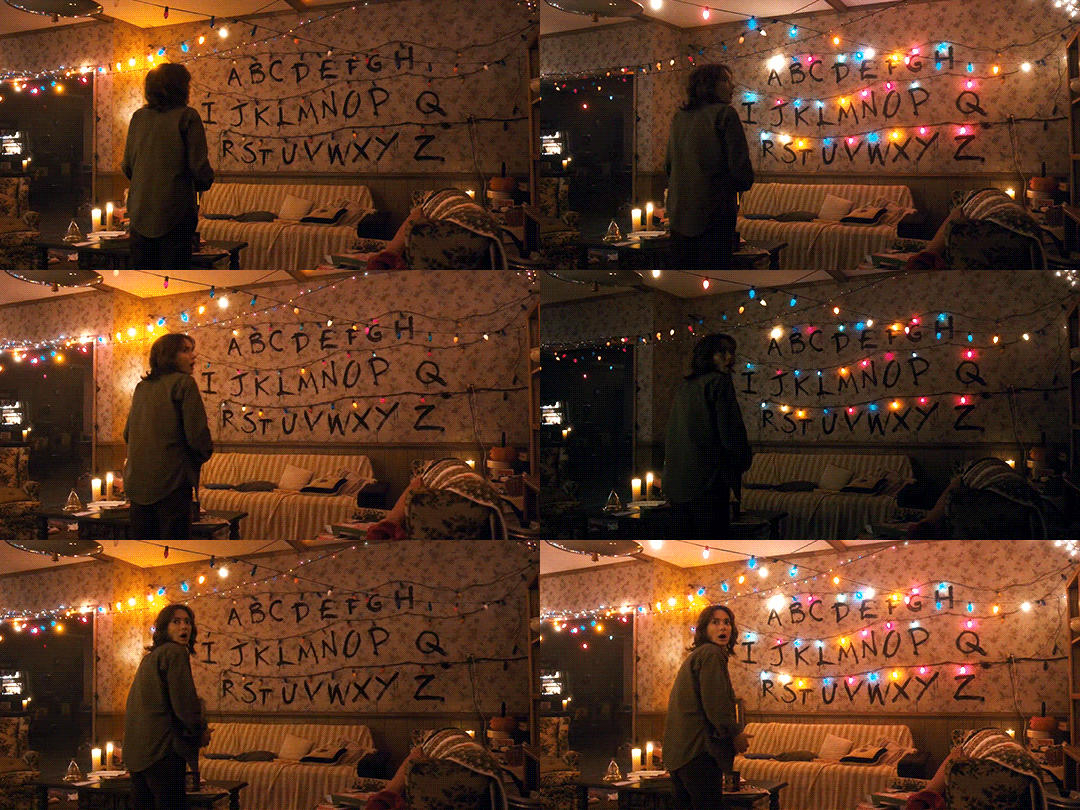
The real skill isn’t just performing well, it’s also about noticing who you’re becoming along the way. If work changed you, a question worth asking is- Do you like who it’s shaping you into?
Thank You for reading our Blogs and Learning from our experience.
For your daily dose of life in all its beauty & imperfections

Masternee
Your Mind’s Favourite Blog
Copyright © 2024 Masternee. All Rights Reserved.