


Freedom and happiness are what we all seek, yet most of us remain trapped- cycling through job changes, new habits, and fresh starts, only to find ourselves back where we began.
The Courage to Be Disliked by Ichiro Kishimi and Fumitake Koga confronts this cycle head-on. Structured as a Socratic dialogue between a philosopher and a restless young man, the book draws on the teachings of Alfred Adler—the lesser-known yet deeply influential third giant of modern psychology, whose ideas quietly shaped classics like How to Win Friends and Influence People and The 7 Habits of Highly Effective People.
Its promise is radical yet simple: change how you think, and you can break free from others’ expectations and define happiness on your own terms.
Freud, Jung, and Adler are all famous psychologists, but they saw human behaviour in very different ways.
Freud believed human behaviour is driven by unconscious desires and inner conflicts, while Jung expanded this further with the idea of a collective unconscious such as shared symbols and archetypes, pointing toward spiritual wholeness.
Adler broke away from both, arguing that what truly drives us isn’t hidden forces or primal urges, but a deeply felt sense of inferiority—the universal human need to feel capable and valued. Rather than being prisoners of our past or unconscious mind, Adler saw people as goal-oriented beings, shaped by conscious choices and the desire to belong and contribute meaningfully to society.
For Adler, lasting change doesn’t require excavating childhood wounds or decoding dreams, it comes from shifting how we think, redefining our goals, and taking responsibility for the life we choose to live.
Adler argues that our experiences don’t determine our lives; we simply use them as convenient excuses. If the past truly controlled us, life would collapse into pessimism. Yet how often do we say, “I’m this way because of my childhood” or “I can’t trust people after what happened to me”? We blame yesterday for today, rarely pausing to ask whether our present choices matter more.
Adler’s answer lies in what he calls “lifestyle”, your worldview, your outlook on life. You weren’t born with it; you developed it over time, which means it can be reshaped. Change feels uncomfortable, like trading a familiar car for an unfamiliar one, but it’s entirely possible. The path forward is simple, if not easy: become aware of the worldview holding you back, then choose a new one deliberately. As the philosopher puts it, no matter what has happened in your life up to this point, it need not have any bearing on how you live from here on.
At first, the idea that all problems are interpersonal sounds absurd; surely some struggles are purely personal? But scratch the surface of almost any problem, and you’ll find a relationship at its core. Take low self-confidence: it feels like an internal battle, but beneath it often lies a fear of rejection or being disliked. We tell ourselves we’re “not good enough” as a way to avoid the risk of connection. Even financial anxiety, which feels entirely private, is rooted in systems and structures built by and for human society; strip away other people, and money loses all meaning.
This reframe is one of the book’s most powerful insights. Issues like inferiority, competitiveness, power struggles, and self-worth aren’t isolated personal struggles; they’re products of how we relate to others. And that’s quietly liberating: if our problems are interpersonal in origin, then changing how we think about our relationships holds the power to change how we live.
Life tasks arise naturally from living. You are born dependent, but over time you grow into self-reliance. Along the way, you form relationships—professional, social, and deeply personal. Adler identified three primary tasks of life:
These tasks differ in distance and depth.
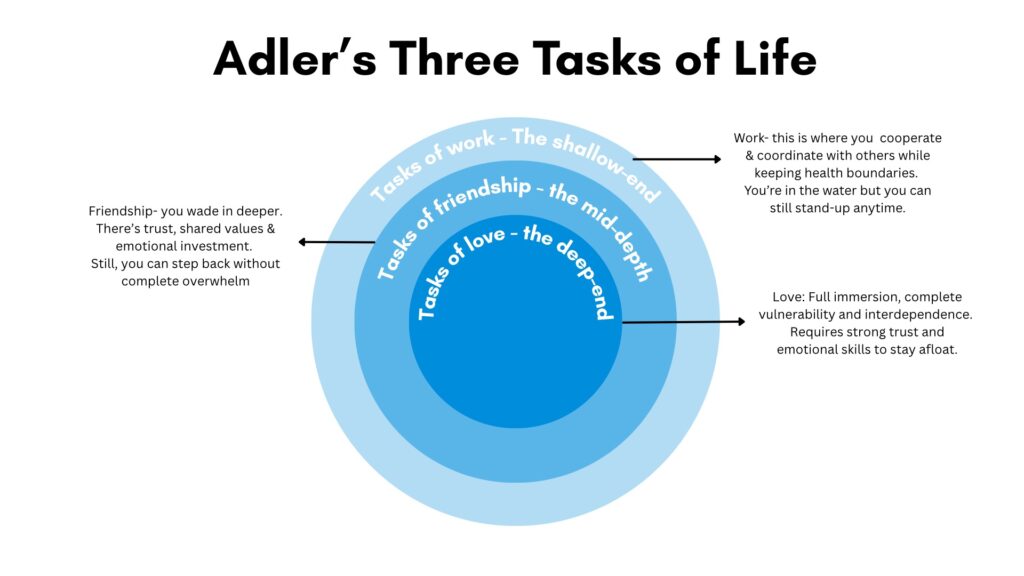
Most interpersonal conflicts arise when we interfere in someone else’s task, whether as a parent, partner, or colleague. Adler offers a simple filter: who ultimately bears the consequences of this decision? If it isn’t you, it isn’t your task. This means worrying about whether others like us, approve of us, or validate our choices is a misdirection of energy. Our job is to do our own work well, without hiding behind what Adler calls “life lies,” the excuses we use to avoid showing up fully for our own lives.
The separation of tasks isn’t about detachment; it’s about clarity. It frees us from unnecessary battles and keeps us focused on what is genuinely ours to carry.
Most of us imagine freedom as the ability to do whatever we please—no rules, no restrictions. But Adler challenges this. True freedom, he argues, is living without the need for recognition. The moment we begin shaping our behaviour to earn approval, from parents, partners, or strangers on social media, we surrender our autonomy. Our choices stop reflecting our values and start passing through an exhausting filter: “Will they like me for this?” Recognition feels like proof that we matter, but Adler warns it’s an illusion. When your self-worth depends on external validation, you’ve handed the reins of your life to someone else.
True freedom, then, is the courage to live authentically without being enslaved by others’ judgments. It doesn’t mean becoming indifferent or arrogant; it means showing up honestly while accepting that being disliked is sometimes the price of living on your own terms.
Adler’s freedom isn’t the loud rebellion of breaking rules; it’s the quieter, harder act of breaking the invisible chains of needing to be liked.
Adler’s most profound insight is that individuality and community aren’t opposites; they’re interdependent.
We often feel torn between pursuing our own ambitions and sacrificing them for others, but Adler sees this as a false choice.
He uses the term Gemeinschaftsgefühl, “social interest” or “community feeling”, to describe the idea that personal growth only finds meaning when connected to something larger than ourselves. Like a tree in a forest, we are unique in our own right, yet deeply reliant on the ecosystem around us.
Adler takes this further, urging us to extend our sense of belonging beyond family or nationality, to humanity, the earth, and the universe itself. Identities anchored in narrow institutions are fragile; they collapse when those institutions change.
This is what Adler means by individuality: not self-expression for its own sake, but taking responsibility for your unique strengths and contributing them to the wider whole. Community doesn’t demand conformity; it demands contribution. And individuality isn’t selfishness, it’s showing up fully as yourself, in service of others.
We become most ourselves not by withdrawing from the world, but by daring to connect with it; authentically, courageously, and without waiting for recognition.
Adler warns against vertical relationships, those built on hierarchy, comparison, and competition. From childhood, we’re conditioned to see ourselves on a ladder: who is smarter, richer, more admired. This fuels both superiority and inferiority complexes, leaving us constantly performing, yet rarely feeling truly seen.
Adler’s alternative is horizontal relationships, built on equality and mutual respect, where the question shifts from “Am I better or worse?” to “How do we walk alongside each other?” Belonging comes not from outperforming, but from participating.
Central to this is the difference between praise and encouragement. Praise reinforces hierarchy; encouragement affirms effort and contribution without invoking comparison—“I see how hard you tried” rather than “You did better than the rest.” When we relate to others this way, we escape the exhausting game of comparison and create spaces where people feel valued simply for being present. The deepest human need, Adler reminds us, isn’t to be above others, it’s to belong with them.
Adler invites us to stop seeing life as a straight line, past leading to present, present leading to future, and instead experience it as a series of moments, each complete in itself.
Think of climbing a mountain: the summit gives you direction, but your life is happening with every step, every breath, every shifting view. Fixate only on the peak, and you miss the journey entirely. Meaning, Adler suggests, isn’t stored at some distant destination; it lives in how fully you inhabit this step.
He also reminds us not to take life too seriously. Life has no inherent meaning or cosmic scoreboard; the weight of purpose is something we create, and we do so through contribution.
Just as a climber’s journey is enriched not only by reaching the summit but by supporting fellow climbers along the way, our lives gain meaning through how we show up for others.
When we embrace this, the pressure to have everything figured out dissolves. All that remains is the next step, taken fully, and in connection with those around us.
The Courage to Be Disliked distills Adlerian psychology into lessons that feel startlingly relevant today.
It challenges us to see our struggles less as products of circumstance and more as products of how we relate to others.
His definition of freedom, living unconcerned with others’ approval, feels almost tailor-made for the age of social media. And his invitation to live in the now reminds us to stop chasing distant meaning and start creating it, step by step, through how we show up for others.
So why read the book if you’ve just gone through this summary? Because Adler’s ideas aren’t just lessons to know, they’re perspectives to live.
Thank You for reading our Blogs and Learning from our experience.
For your daily dose of life in all its beauty & imperfections

Masternee
Your Mind’s Favourite Blog
Copyright © 2024 Masternee. All Rights Reserved.