
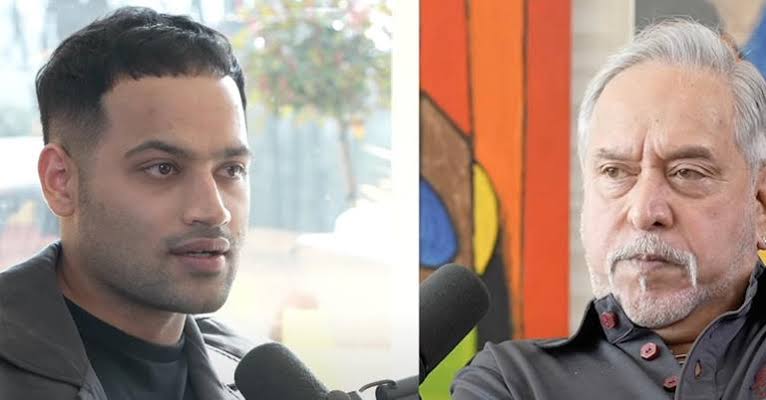
In a media moment that turned heads across the country, entrepreneur-turned-podcaster Raj Shamani sat down with Vijay Mallya- a man once known as the “King of Good Times” and now better known as a fugitive economic offender. This interview was one of the most anticipated and the curiosity was real.
Yet, for all its hype, the conversation raised important questions about accountability, privilege, and the shifting power dynamics in Indian media.
Let’s start with the obvious: no Indian journalist has managed to get Mallya on record in nearly a decade. And here comes Raj Shamani, a popular youth content creator with zero background in investigative journalism, flying to London to speak with him casually over coffee.
It was a coup of sorts—one that exposed just how much traditional Indian media has either been blocked, disinterested, or ineffective when it comes to holding the powerful accountable on foreign soil.
1. A Landmark Media Moment in New-Age Journalism
The fact that Mallya agreed to this podcast, when he has actively avoided Indian courts and journalists, is significant. Raj Shamani used the trust he’s built with audiences to humanize a man most people only know from headlines.
For many, especially Gen Z and Millennials, this was their first time hearing Mallya speak directly, unfiltered. The accessibility of the podcast medium—on YouTube, Instagram, and Spotify—meant that millions heard his version, not just the state or media version. That in itself made it a culturally significant moment.
2. Challenging the One-Sided Narrative
Mallya used the platform to push back on the idea that he was a “thief who ran away.” He pointed fingers at Indian banks for lending recklessly, claimed political targeting, and alleged media sensationalism.
These critiques resonate with many Indians who are increasingly skeptical of both the government and mainstream media. In a post-truth era, people are hungry for alternative perspectives—even if they come from disgraced billionaires.
3. New Media > Legacy Media?
This episode is a turning point in how news is consumed in India. Traditional news media often fail to get access due to red tape, corporate interests, or political pressure. Meanwhile, creators like Raj are building direct bridges to powerful figures.
There’s growing disillusionment with TV news in India, especially among younger audiences. Raj’s interview felt fresh, neutral (at least on the surface), and intimate. It gave the illusion of honesty, even if the content didn’t always deliver on that promise.
1. It Was More PR Campaign Than Cross-Examination
From the lighting to the tone to the illusion of asking of challenging questions—it all felt like a tightly managed PR operation. Mallya was framed not as a man facing extradition and dozens of charges, but as a misunderstood entrepreneur looking for redemption. If he was really that innocent, why flee the country using a diplomatic passport? Why the repeated delays for his extradition from the UK? Why justify the lavish birthday celebrations while the employees begged for pending salaries?
By allowing Mallya to tell an emotionally compelling story without evidence or rebuttal, the podcast unintentionally (or perhaps strategically) became a space for reputation management. The journalistic responsibility to present both sides of the story was completely missing.
2. False Equivalence Between Victimhood and Accountability
Mallya frequently positioned himself as the scapegoat, “a high-profile entrepreneur punished for failing where others have failed too.” That narrative, while seductive, does a disservice to hundreds of employees, investors, and small vendors who suffered real, material losses due to his company’s collapse.
Redemption begins with responsibility. Mallya has never publicly acknowledged the pain caused to his employees or their families. His interviews continue to center around his image, his pain, and his version of the truth.
3. A Missed Opportunity for Real Dialogue
While there were a few seemingly hard questions asked, there was no real pushback.
Mallya responded with broad deflections—blaming operational cash flow issues for nan-payment of salaries, painting himself as a victim of political vendetta, and repeating his stance that he left India legally. Yet, these responses went largely unchallenged. There was no demand for clarity, no counter-evidence, no pressing on the human cost of his actions.
For instance:
The result? A conversation that appeared bold on the surface but gave Mallya space to control the narrative and frame his comeback arc.
This entire episode exposes how badly Indian journalism needs to reclaim its ground.
Mallya seemed ready for a conversation. But mainstream outlets either couldn’t—or wouldn’t—make it happen. Whether due to corporate pressures, political alignments, or logistical failures, they left a gaping hole that influencers like Raj are now stepping into.
The result? A dangerous blend of charisma, content, and compromised context.
Vijay Mallya’s podcast appearance may go down in content history, but it won’t be remembered for uncovering the truth and presenting the facts as they were. It will be remembered as a symbol of what happens when power meets opportunity.
Mallya may have had his say, but it’s the media’s job to ask the hard questions and let people make informed judgments—not just go viral. The interview is a reminder that while social media may have democratized storytelling, it still needs editorial courage and journalistic rigour.
Let’s not forget: The “King of Good Times” left behind a long trail of bad ones. Someone still needs to ask the right questions.
Thank You for reading our Blogs and Learning from our experience.
For your daily dose of life in all its beauty & imperfections

Masternee
Your Mind’s Favourite Blog
Copyright © 2024 Masternee. All Rights Reserved.